Episode 6: The Great Shell Game
Sep. 17th, 2025 04:50 pm![[personal profile]](https://www.dreamwidth.org/img/silk/identity/user.png) azdak posting in
azdak posting in ![[community profile]](https://www.dreamwidth.org/img/silk/identity/community.png) aliassmithjones
aliassmithjonesThis is one of my very favourite episodes. As mentioned in the previous review, it separates our heroes so the actors could work on two episodes simultaneously, but this time there’s an artistic consistency to the policy - I don’t believe there’s a single shot which features both Heyes and Curry, and yet the story works perfectly.
The episode starts with Heyes’s half of the plot and then moves on to the Kid’s, which is told in flashback. This non-linear narrative approach enhances the effect, because a lot of the episode’s strengths come from how it only gradually reveals what’s going on, keeping the audience guessing, and we really have no idea what role the Kid plays in all this (or we wouldn’t, it if weren’t for the teaser, which is a big fat SPOILER) until we get to his part, and even then we have to watch the whole thing play out before we really understand.
We open with an aerial shot of a county fair, with balloons and jugglers and hurdy-gurdies, and lots of well-dressed, wealthy citizens in pretty dresses and top hats, a far cry from our usual back-of-beyond small town milieu. This is followed by a shot of a man’s legs in a pair of close-fitting black boots, walking unhurriedly but deliberately behind a row of carriages. The camera pans up and it’s Heyes, though those are definitely not his usual boots. He’s also wearing a fancier jacket than usual and a Southern-looking ribbon under his collar. Luckily for us, his black Stetson is still fairly new at this point – you can chart where you are in the series by how much of a battering Heyes’s hat has taken – so he hasn’t needed to change that. He comes round to the camera side of one of the carriages, checks no one is watching, then gets out some kind of tool and surreptitiously fiddles with the pin fixing the axle to the wheel. Ok, so Heyes is up to something.
Then we cut to a well-dressed man at the fair. He spots a young woman walking through the crowd and introduces himself as Charles Morgan, then asks the lady if he might drive her back to her hotel. You can tell by her face that she has zero interest in being driven anywhere by this slimeball. Unusually for a man, he senses her reluctance and says “I realise we haven’t been properly introduced, however I …” The young woman spots her opportunity and allows a pretty smile to light up her face. “That’s right,” she says, “we haven’t. And I prefer to drive myself.” And off she stalks, leaving a smitten Morgan in her wake. I, too, am smitten. This is what I’ve been waiting for! A woman with a mind of her own! A woman who can drive herself! Unlike Morgan, though, I’m pretty confident I’ll be seeing her again.
Sure enough, her carriage turns out to be the one Heyes fiddled with, and sure enough, when the wheel falls off, who should happen to pass by soon after but that helpful Mr Smith. She has to flag him down – Heyes pretends he was going to ride right past – and though he fixes the wheel, he makes her get her hands dirty helping him, which is clearly not the sort of effect the damsel was expecting to have on her white knight. She tells him she’s staying at the Mineral Springs Hotel and Heyes says what a coincidence, that’s where he’s staying. By now it’s obvious that he’s engineered this meet-cute in order to make her acquaintance, but we still don’t know why.
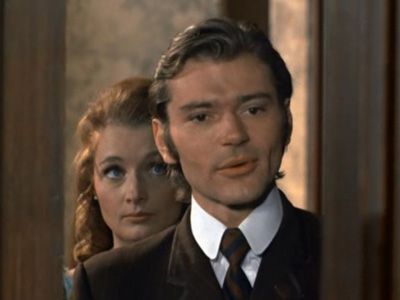
The next scene is the two of them having dinner at a fancy restaurant with an orchestra playing classical music. This new, smoother version of Heyes fits right in. We finally learn that the woman’s name is Grace Turner and she’s a wealthy widow from Pennsylvania. She’s wearing a blue dress that shows enough cleavage to make it clear she’s no longer in mourning and the most godawful hairdo. Heyes is wearing an expensive-looking dark brown suit and tie - not his usual city suit, as seen in The McCreedy Bust, but one with a stripe in it that Mervyn Bunter would no doubt describe as a remote amber. Then Mrs Turner finds a wallet under the table with a load of cash in it and a business card with some kind of code on the back, and that nice Mr Smith insists, against Mrs Turner’s ill-concealed reluctance, on returning it to its owner. And at this point my heart leaps gleefully in my chest. It’s a con! It has to be!
I LOVE a good con. And this is a really good one. In fact it’s so good, it was used again in The Sting (RIP Robert Redford, I will be watching Butch Cassidy and the Sundance Kid tonight in your honour), though I feel constrained to point out that The Sting was released two years after The Great Shell Game, so if there was any nicking going on, for once it wasn’t the ASJ writers what done it. The con is called the Big Store, and it’s the one where they set up a fake bookie’s office with the results of horse races coming through by telegram and all the punters are played by fellow con men. Obviously Heyes doesn’t have the resources to set this up by himself, so we get to meet an old friend of his, “Soapy” Sullivan, who has come out of retirement to help him out as a quid pro quo for Heyes saving his life a couple of years ago. Soapy in turn knows someone who travels around pulling this con in various different towns and Charles Morgan (the guy who offered Grace a lift) works for that person. Got it?
Heyes, for reasons as yet unknown, is going to pull the con on Grace Turner. To this end, he slips into the role of a wealthy silver mine owner and honest young man – a bit too honest, for Grace’s tastes. Grace, it rapidly becomes clear, is nowhere near as rich as she pretends to be and a great deal more interested in money than is considered becoming in a young woman. In classic con fashion, Mr Smith constantly puts the brakes on Grace’s enthusiasm, making her think it was all her idea to go along with the get-rich-quick scheme. The two of them get along like a house on fire, especially once she finds out about the silver mine, and they eventually mash lips outside her hotel room. This makes Heyes a bit conflicted. He’s so conflicted, in fact, that Soapy asks him if he wants to call the scam off. “Might not have to,” says Heyes. “She’s a pretty smart girl. She might just take the money and run off with it.” Gosh, it’s nice to see a woman on ASJ appreciated for her intelligence! And due credit to Diana Muldaur for making Grace Turner actually seem intelligent, not to mention brilliantly manipulative. Soapy says no one runs out on the Big Store and Heyes pulls himself together and commits. Complex plot shenanigans ensue until the trap has almost sprung and all Grace has to do is scratch together $10,000 in cash in order for her ostensible winnings of $120,000 to be released.
Heyes goes back to his room and find Charles Morgan waiting for him with a gun. It turns out that he and Heyes were both in Plummer’s gang back in the day (hooray for continuity! Even if Plummer's first name has here mysteriously morphed from Jim into Al) and know each other well enough for Heyes to address him as Chuck. Morgan has fallen hard for Grace Turner and objects to her being made the mark for a scam. It’s a very nice, tense little scene, with Heyes trying to give Chuck an explanation, the audience eager to finally hear one, and Morgan constantly frustrating us with his refusal to listen. Eventually, though, Heyes being Heyes, he manages to talk him round – and asks him if he remembers Kid Curry. Sure, says Morgan, I remember Kid Curry – wait a minute, whaddya mean, REMEMBER?? And with Heyes as the narrator, we launch into the Kid’s half of the story.
The Kid has lost a coin toss – it’s ASJ canon that the Kid ALWAYS loses coin tosses – and is trying to deliver a letter or a package or something to what the Russians would call a “toilet village” in Mexico. By himself.
Circumstances lead him to a meeting with Grace Turner, who has washed up there for reasons she remains enigmatic about, and who offers him a job as her bodyguard while she delivers some diamonds to someone in the US. Since the Kid has no money and hasn’t eaten since yesterday, he’s quick to take her up on the offer. The scene where she propositions him (with the job! She’s still playing the role of respectable lady at this point) is really cute, with the Kid nice but out of his depth and Grace running rings around him. She soon has him figured out and plays the helpless little lady, telling him she’s frightened and inexperienced (at delivering diamonds, obvs) and will put herself in his hands and do whatever he says. The Kid laps it up. Then he saves her from a rattlesnake when she’s in her underwear after a swim and she trembles on his shoulder and eventually they share a candlelight snog to the strains of a Mexican guitar. And then they arrive in the US and the person she’s supposed to deliver the “diamonds” to turns out to be a sheriff, who knows full well that the man with her is Kid Curry. The Kid gets thrown in jail and Grace gets the $10,000 reward. But there’s a twist! Grace really has fallen for the Kid, and though she loves money more, she’s not about to abandon him. She surreptitiously pokes a note through the grid on the window of his cell, which assures him she meant every word she said and adds that if he has any faith left in her he'll get under his bunk as soon as he can. It takes a moment for the import of this to percolate through the Kid’s brain, but once he grasps it, he reacts like lightning. A bunch of dynamite goes off and blows a great big hole in the cell wall. The Kid scrambles through and hightails it out on a horse Grace has thoughtfully provided.
And that would be the end, except it now looks as if Kid Curry and Grace Turner were in cahoots to swindle the railroads out of the reward money. The only way to clear the Kid’s name is to get the money back, hence the con.
We jump back to the present. Mrs Turner and Mr Smith hand over their $10,000 each to the bookie and are shown into a side room to wait for their winnings. Heyes says he needs to step out for a moment. Left alone, Grace looks up from her menu and sees Kid Curry standing by the door, wearing his dreadful grey city suit and an absolutely massive smirk. She realises instantly that she’s been conned, but it takes a moment for it all to sink in. Then she tells him he must have needed the money badly to go to so much trouble - I believe by her standards this constitutes an apology - and asks if he has enough left to buy a girl dinner. The Kid accedes and and tells her that Mr Smith is waiting for them at the hotel, adding “He tells me he fell as madly in love with you as I did.” Grace smiles. “That makes three of us,” she says, and they walk off together, hand in hand, for what is quite obviously going to be a mutually satisfactory farewell threesome. Was this a 1970s thing? Or just an ASJ thing? Or an inherited-from-Butch-Cassidy-and-the-Sundance-Kid thing? As the saying goes, if I had a nickel every time it happened on the show, I’d have two nickels, but it’s weird that it happened twice.
Ah well, it’s none of my business what three consenting adults get up to in the privacy of the Mineral Springs Hotel. And, either way, I love this episode. I love a woman with an agenda and Grace has one in spades. Not only that, her agenda is essential to the plot, which is a sad rarity in ASJ. And she has great character interactions with both our heroes. The Kid really shines in his scenes with her, especially the humorous parts, and Heyes shines both in his role as a suave silver mine owner and in his slightly conflicted relationship with Grace. The two of them are a good match, neither trusting the other as far as they can throw them, but both appreciating each other’s abilities (and, obviously, hotness. There is no way Chuck Morgan is ever going to get a look-in).
I also love how despite the insane deadline they were working to, the writers managed to show in considerable detail how a long con works, including how to reel in a mark. All my knowledge of cons comes, I must admit, from the BBC’s "Hustle", but I feel that The Great Shell Game goes one better. While "Hustle" always insisted (in the teeth of all the evidence) that “You can’t con an honest man,” Chuck Morgan says “The first rule of the Big Store is to find people who are basically crooked themselves, so that they don’t run to the police every time you take them.” Surely a more accurate understanding of human nature?
And finally, a couple of random observations.
1. Considering that the amnesty was supposed to be a secret between the boys, Lom and the Governor, Heyes is surprisingly willing to share the information with every Tom, Dick and Harry he meets. Now Chuck Morgan knows about it, too.
2. Grace calls the Kid “Jed”, and with good reason, since he identifies himself as Jed Curry right in front of her. I think this may be the only time the name is ever used? Maybe the writers were trying something out, as the next episode features the only person ever to call Heyes “Hannibal”. Personally, I really like the name Jed. We will draw a veil over Hannibal. It’s my head canon that not even his parents called him that, instead using some nickname that he found embarrassing enough as a teenager to insist on going by Heyes from then on.
The episode starts with Heyes’s half of the plot and then moves on to the Kid’s, which is told in flashback. This non-linear narrative approach enhances the effect, because a lot of the episode’s strengths come from how it only gradually reveals what’s going on, keeping the audience guessing, and we really have no idea what role the Kid plays in all this (or we wouldn’t, it if weren’t for the teaser, which is a big fat SPOILER) until we get to his part, and even then we have to watch the whole thing play out before we really understand.
We open with an aerial shot of a county fair, with balloons and jugglers and hurdy-gurdies, and lots of well-dressed, wealthy citizens in pretty dresses and top hats, a far cry from our usual back-of-beyond small town milieu. This is followed by a shot of a man’s legs in a pair of close-fitting black boots, walking unhurriedly but deliberately behind a row of carriages. The camera pans up and it’s Heyes, though those are definitely not his usual boots. He’s also wearing a fancier jacket than usual and a Southern-looking ribbon under his collar. Luckily for us, his black Stetson is still fairly new at this point – you can chart where you are in the series by how much of a battering Heyes’s hat has taken – so he hasn’t needed to change that. He comes round to the camera side of one of the carriages, checks no one is watching, then gets out some kind of tool and surreptitiously fiddles with the pin fixing the axle to the wheel. Ok, so Heyes is up to something.
Then we cut to a well-dressed man at the fair. He spots a young woman walking through the crowd and introduces himself as Charles Morgan, then asks the lady if he might drive her back to her hotel. You can tell by her face that she has zero interest in being driven anywhere by this slimeball. Unusually for a man, he senses her reluctance and says “I realise we haven’t been properly introduced, however I …” The young woman spots her opportunity and allows a pretty smile to light up her face. “That’s right,” she says, “we haven’t. And I prefer to drive myself.” And off she stalks, leaving a smitten Morgan in her wake. I, too, am smitten. This is what I’ve been waiting for! A woman with a mind of her own! A woman who can drive herself! Unlike Morgan, though, I’m pretty confident I’ll be seeing her again.
Sure enough, her carriage turns out to be the one Heyes fiddled with, and sure enough, when the wheel falls off, who should happen to pass by soon after but that helpful Mr Smith. She has to flag him down – Heyes pretends he was going to ride right past – and though he fixes the wheel, he makes her get her hands dirty helping him, which is clearly not the sort of effect the damsel was expecting to have on her white knight. She tells him she’s staying at the Mineral Springs Hotel and Heyes says what a coincidence, that’s where he’s staying. By now it’s obvious that he’s engineered this meet-cute in order to make her acquaintance, but we still don’t know why.
The next scene is the two of them having dinner at a fancy restaurant with an orchestra playing classical music. This new, smoother version of Heyes fits right in. We finally learn that the woman’s name is Grace Turner and she’s a wealthy widow from Pennsylvania. She’s wearing a blue dress that shows enough cleavage to make it clear she’s no longer in mourning and the most godawful hairdo. Heyes is wearing an expensive-looking dark brown suit and tie - not his usual city suit, as seen in The McCreedy Bust, but one with a stripe in it that Mervyn Bunter would no doubt describe as a remote amber. Then Mrs Turner finds a wallet under the table with a load of cash in it and a business card with some kind of code on the back, and that nice Mr Smith insists, against Mrs Turner’s ill-concealed reluctance, on returning it to its owner. And at this point my heart leaps gleefully in my chest. It’s a con! It has to be!
I LOVE a good con. And this is a really good one. In fact it’s so good, it was used again in The Sting (RIP Robert Redford, I will be watching Butch Cassidy and the Sundance Kid tonight in your honour), though I feel constrained to point out that The Sting was released two years after The Great Shell Game, so if there was any nicking going on, for once it wasn’t the ASJ writers what done it. The con is called the Big Store, and it’s the one where they set up a fake bookie’s office with the results of horse races coming through by telegram and all the punters are played by fellow con men. Obviously Heyes doesn’t have the resources to set this up by himself, so we get to meet an old friend of his, “Soapy” Sullivan, who has come out of retirement to help him out as a quid pro quo for Heyes saving his life a couple of years ago. Soapy in turn knows someone who travels around pulling this con in various different towns and Charles Morgan (the guy who offered Grace a lift) works for that person. Got it?
Heyes, for reasons as yet unknown, is going to pull the con on Grace Turner. To this end, he slips into the role of a wealthy silver mine owner and honest young man – a bit too honest, for Grace’s tastes. Grace, it rapidly becomes clear, is nowhere near as rich as she pretends to be and a great deal more interested in money than is considered becoming in a young woman. In classic con fashion, Mr Smith constantly puts the brakes on Grace’s enthusiasm, making her think it was all her idea to go along with the get-rich-quick scheme. The two of them get along like a house on fire, especially once she finds out about the silver mine, and they eventually mash lips outside her hotel room. This makes Heyes a bit conflicted. He’s so conflicted, in fact, that Soapy asks him if he wants to call the scam off. “Might not have to,” says Heyes. “She’s a pretty smart girl. She might just take the money and run off with it.” Gosh, it’s nice to see a woman on ASJ appreciated for her intelligence! And due credit to Diana Muldaur for making Grace Turner actually seem intelligent, not to mention brilliantly manipulative. Soapy says no one runs out on the Big Store and Heyes pulls himself together and commits. Complex plot shenanigans ensue until the trap has almost sprung and all Grace has to do is scratch together $10,000 in cash in order for her ostensible winnings of $120,000 to be released.
Heyes goes back to his room and find Charles Morgan waiting for him with a gun. It turns out that he and Heyes were both in Plummer’s gang back in the day (hooray for continuity! Even if Plummer's first name has here mysteriously morphed from Jim into Al) and know each other well enough for Heyes to address him as Chuck. Morgan has fallen hard for Grace Turner and objects to her being made the mark for a scam. It’s a very nice, tense little scene, with Heyes trying to give Chuck an explanation, the audience eager to finally hear one, and Morgan constantly frustrating us with his refusal to listen. Eventually, though, Heyes being Heyes, he manages to talk him round – and asks him if he remembers Kid Curry. Sure, says Morgan, I remember Kid Curry – wait a minute, whaddya mean, REMEMBER?? And with Heyes as the narrator, we launch into the Kid’s half of the story.
The Kid has lost a coin toss – it’s ASJ canon that the Kid ALWAYS loses coin tosses – and is trying to deliver a letter or a package or something to what the Russians would call a “toilet village” in Mexico. By himself.
Circumstances lead him to a meeting with Grace Turner, who has washed up there for reasons she remains enigmatic about, and who offers him a job as her bodyguard while she delivers some diamonds to someone in the US. Since the Kid has no money and hasn’t eaten since yesterday, he’s quick to take her up on the offer. The scene where she propositions him (with the job! She’s still playing the role of respectable lady at this point) is really cute, with the Kid nice but out of his depth and Grace running rings around him. She soon has him figured out and plays the helpless little lady, telling him she’s frightened and inexperienced (at delivering diamonds, obvs) and will put herself in his hands and do whatever he says. The Kid laps it up. Then he saves her from a rattlesnake when she’s in her underwear after a swim and she trembles on his shoulder and eventually they share a candlelight snog to the strains of a Mexican guitar. And then they arrive in the US and the person she’s supposed to deliver the “diamonds” to turns out to be a sheriff, who knows full well that the man with her is Kid Curry. The Kid gets thrown in jail and Grace gets the $10,000 reward. But there’s a twist! Grace really has fallen for the Kid, and though she loves money more, she’s not about to abandon him. She surreptitiously pokes a note through the grid on the window of his cell, which assures him she meant every word she said and adds that if he has any faith left in her he'll get under his bunk as soon as he can. It takes a moment for the import of this to percolate through the Kid’s brain, but once he grasps it, he reacts like lightning. A bunch of dynamite goes off and blows a great big hole in the cell wall. The Kid scrambles through and hightails it out on a horse Grace has thoughtfully provided.
And that would be the end, except it now looks as if Kid Curry and Grace Turner were in cahoots to swindle the railroads out of the reward money. The only way to clear the Kid’s name is to get the money back, hence the con.
We jump back to the present. Mrs Turner and Mr Smith hand over their $10,000 each to the bookie and are shown into a side room to wait for their winnings. Heyes says he needs to step out for a moment. Left alone, Grace looks up from her menu and sees Kid Curry standing by the door, wearing his dreadful grey city suit and an absolutely massive smirk. She realises instantly that she’s been conned, but it takes a moment for it all to sink in. Then she tells him he must have needed the money badly to go to so much trouble - I believe by her standards this constitutes an apology - and asks if he has enough left to buy a girl dinner. The Kid accedes and and tells her that Mr Smith is waiting for them at the hotel, adding “He tells me he fell as madly in love with you as I did.” Grace smiles. “That makes three of us,” she says, and they walk off together, hand in hand, for what is quite obviously going to be a mutually satisfactory farewell threesome. Was this a 1970s thing? Or just an ASJ thing? Or an inherited-from-Butch-Cassidy-and-the-Sundance-Kid thing? As the saying goes, if I had a nickel every time it happened on the show, I’d have two nickels, but it’s weird that it happened twice.
Ah well, it’s none of my business what three consenting adults get up to in the privacy of the Mineral Springs Hotel. And, either way, I love this episode. I love a woman with an agenda and Grace has one in spades. Not only that, her agenda is essential to the plot, which is a sad rarity in ASJ. And she has great character interactions with both our heroes. The Kid really shines in his scenes with her, especially the humorous parts, and Heyes shines both in his role as a suave silver mine owner and in his slightly conflicted relationship with Grace. The two of them are a good match, neither trusting the other as far as they can throw them, but both appreciating each other’s abilities (and, obviously, hotness. There is no way Chuck Morgan is ever going to get a look-in).
I also love how despite the insane deadline they were working to, the writers managed to show in considerable detail how a long con works, including how to reel in a mark. All my knowledge of cons comes, I must admit, from the BBC’s "Hustle", but I feel that The Great Shell Game goes one better. While "Hustle" always insisted (in the teeth of all the evidence) that “You can’t con an honest man,” Chuck Morgan says “The first rule of the Big Store is to find people who are basically crooked themselves, so that they don’t run to the police every time you take them.” Surely a more accurate understanding of human nature?
And finally, a couple of random observations.
1. Considering that the amnesty was supposed to be a secret between the boys, Lom and the Governor, Heyes is surprisingly willing to share the information with every Tom, Dick and Harry he meets. Now Chuck Morgan knows about it, too.
2. Grace calls the Kid “Jed”, and with good reason, since he identifies himself as Jed Curry right in front of her. I think this may be the only time the name is ever used? Maybe the writers were trying something out, as the next episode features the only person ever to call Heyes “Hannibal”. Personally, I really like the name Jed. We will draw a veil over Hannibal. It’s my head canon that not even his parents called him that, instead using some nickname that he found embarrassing enough as a teenager to insist on going by Heyes from then on.


no subject
Date: 2025-09-19 06:35 pm (UTC)no subject
Date: 2025-09-20 06:44 am (UTC)